Cortex Code Desktop
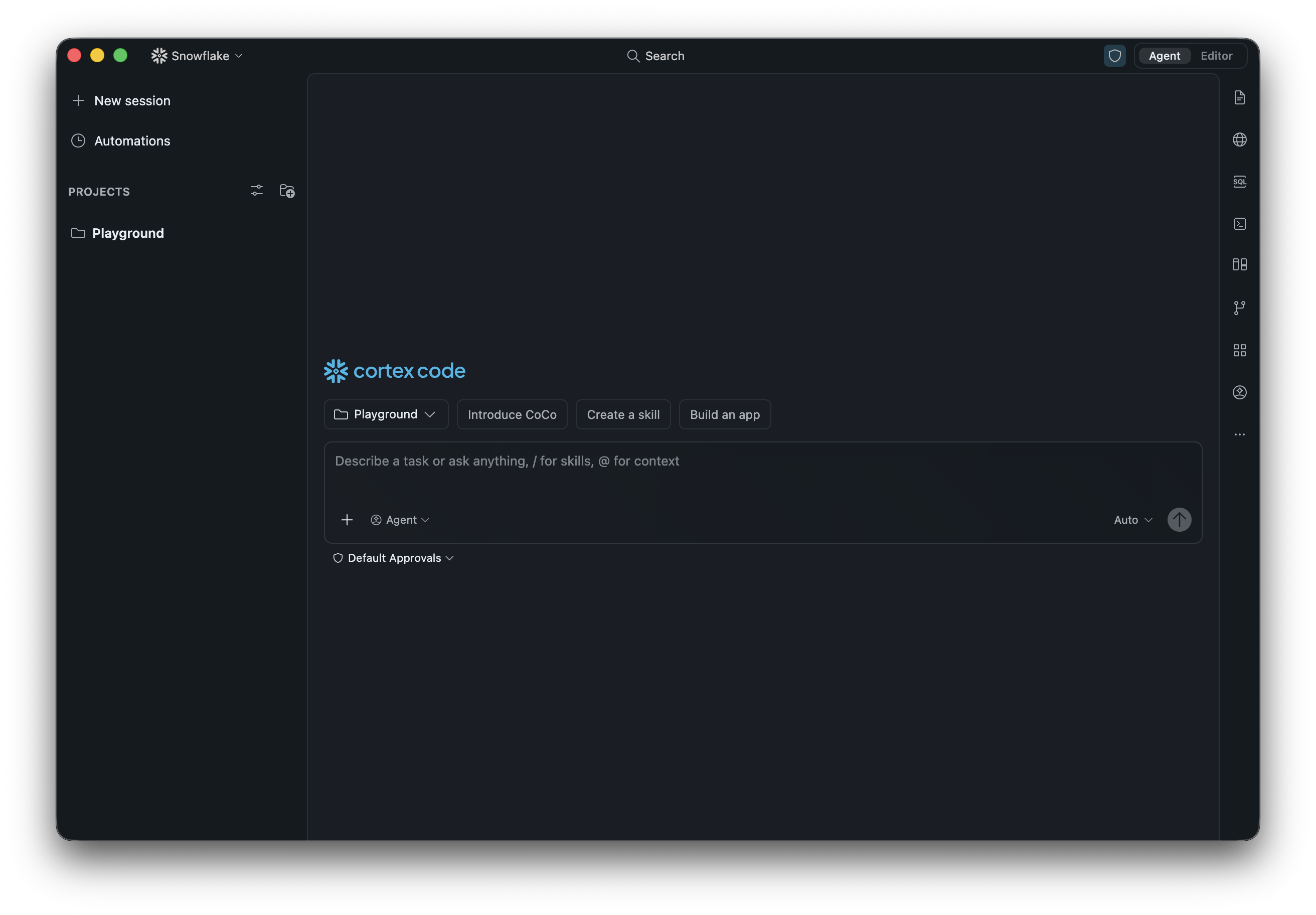
Cortex Code Desktop is a native Mac/Windows desktop application that brings Cortex Code’s full agentic capabilities into an IDE-like surface — file editor, integrated terminal, agentic AI loop, agentic browser, agentic notebook, and deep Snowflake awareness.
Get Cortex Code Desktop
Download the latest version. Available for macOS and Windows.
What’s new
See Release notes for the latest features, improvements, and fixes in each version.
Supported models
Cortex Code Desktop can use the Cortex large language models your account has access to. The model picker in the chat input shows the models currently available to you and is the authoritative, always-current list for your account. Pick or switch the model there at any time.
The lineup includes Claude and OpenAI GPT models and changes as new models are released, so rely on the model picker rather than a fixed list.
Which models you can select depends on your account’s region, your model allowlist
(CORTEX_MODELS_ALLOWLIST), and your cross-region inference setting. For the model identifiers
and the exact cross-region values, see
Cortex Code in Snowsight,
which uses the same controls. If a model isn’t available in your region, enable
cross-region inference. For model access
control, see Control model access.
Get started
| Topic | Description |
|---|---|
| Installation, onboarding, and authentication | Download, install, and sign in |
| Navigation | Agent mode, Editor mode, and layout controls |
| Agent mode and Editor mode | When to use each mode |
| Agent mode and Plan mode | Planning before implementing |
Features
| Topic | Description |
|---|---|
| Agents | Subagents for parallel, specialized tasks |
| Building apps | Scaffold and deploy Streamlit and Snowflake App Runtime apps |
| Data visualization | Inline charts from query results |
| SQL Playground | Run and explore SQL interactively |
| dbt integration | Build, test, and deploy dbt models |
| Agentic browser | Browse and interact with web content |
| Agentic notebook | Jupyter notebooks with AI assistance |
| Automations | Automate recurring agent workflows |
Customization and extensibility
| Topic | Description |
|---|---|
| Plugins | Install or create plugin packages |
| Skills | Custom instructions the agent follows |
| Hooks | Scripts that run on events like session start |
| MCP support | Connect external tools via Model Context Protocol |
| Instruction files | Project-level agent instructions |
| Permission modes | Control what the agent can do without asking |
Monitoring and history
| Topic | Description |
|---|---|
| Usage history view | Monitor usage and token consumption |
Security
| Topic | Description |
|---|---|
| Security | Trust model, recommended baseline, and limits |
| Managed settings | Centrally configure the app for your organization |
| FAQ | Answers to common setup and platform questions |
Legal notices
Where your configuration of Cortex Code uses a model provided on the Model and Service Pass-Through Terms, your use of that model is further subject to the terms for that model on that page.
The data classification of inputs and outputs are as set forth in the following table.
| Input data classification | Output data classification | Designation |
|---|---|---|
| Usage Data | Customer Data | Covered AI Features [1] |
For additional information, refer to Snowflake AI and ML.