RLHF-like long-term memory for Cortex Agents
Turn thumbs-up/down feedback into human-approved lessons that a Cortex Agent retrieves at runtime, with a memory vs. no-memory accuracy eval.
| Stage | Operate, Evaluate, Build |
| Topics | AI Observability, Cortex Agents, Semantic Views |
| Status | GA |
| Time to complete | 45min |
| Edition | Enterprise |
| Regions | Any region with Cortex Agents, Cortex Search, SNOWFLAKE.CORTEX.COMPLETE, and the selected orchestration model |
| Privileges | ACCOUNTADMIN for 01_setup.sql, 02_grant_unredacted.sql, and 99_teardown.sql; the recipe role owns the remaining objects |
| Related skills | agent-studio (bundled with Cortex Code), cortex-ai-function-studio (bundled with Cortex Code) |
| Last verified | 2026-11-10 |
| Authors | Haebichan Jung |
| Code | View all files or download agent-feedback-to-memory.zip, which includes this page as README.md. Teardown: sql/99_teardown.sql |
This recipe is a reference implementation: review the code and adapt it to your environment before production use.
Turning thumbs-up/down feedback from Snowflake Cortex Agents (and CoWork) into human-approved long-term memory that the agent retrieves at runtime. There are no weight updates; the agent learns from people through retrieval.
When to use this
- Users keep hitting the same wrong answer because a business rule lives in people’s heads, such as which revenue measure counts, when the fiscal year starts, or which records are test data.
- You want the fix to come from user feedback and a named approver, and to apply only when a question needs it.
When not to use this:
- The rule applies to every question. Put it in the semantic view or the agent instructions instead.
- You need an evaluation dataset built from feedback. See agent-feedback-to-evals.
- You cannot grant a role access to conversation text. Without
READ UNREDACTED AI OBSERVABILITY EVENTS TABLE, trace text is redacted and there is nothing to diagnose.
How it works
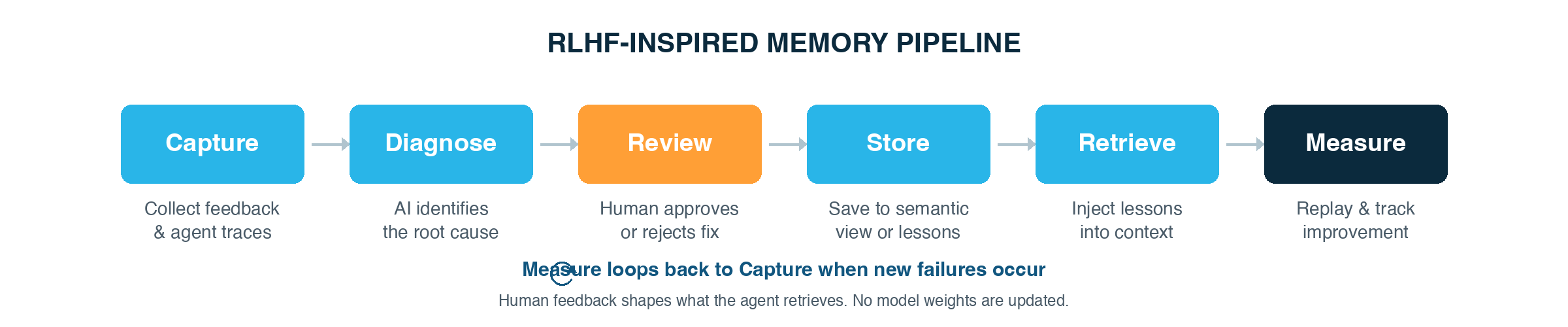
Cortex Agents run on closed-weight models, so you can’t post-train them on user feedback. You can close the loop at inference time instead:
- feedback is captured by the Cortex Agent Feedback API
- AI_COMPLETE joins it to the full trace and drafts a diagnosis (“case file”)
- a domain owner reviews, edits and approves it as a lesson
- approved lessons are indexed by Cortex Search
- on every new question the agent retrieves the relevant lessons and follows them
Prerequisites
| Requirement | Notes |
|---|---|
Cortex Agents, Cortex Analyst, Cortex Search, SNOWFLAKE.CORTEX.COMPLETE | The agents use models.orchestration: auto. The review app drafts case files with claude-sonnet-4-5; set MODEL at the top of app/streamlit_app.py to any model available in your region |
SNOWFLAKE.CORTEX_USER | Granted to the recipe role by 01_setup.sql |
READ UNREDACTED AI OBSERVABILITY EVENTS TABLE | Account-level privilege granted to the recipe role only by 02_grant_unredacted.sql. It lets the role read every conversation with every agent it can monitor, so grant it only to the role that reviews feedback |
Snowflake CLI (snow sql) | Runs the scripts, including the PUT of the seed CSVs. Run from the recipe folder |
| Programmatic access token | Only for eval/run_eval.py; the connection’s password must be a PAT. You create it yourself for your own user |
| Python | requests and snowflake-connector-python for client/agent_client.py and the eval |
Quickstart
From agent-feedback-to-memory/:
snow sql -f sql/01_setup.sql: role, warehouse, database, mock retail data, the naive semantic view, review queue, lessons,LESSONS_SEARCH, both agents, andFEEDBACK_WITH_TRACE. The three demo lessons are loaded.snow sql -f sql/02_grant_unredacted.sqlasACCOUNTADMIN: lets the recipe role read trace text.- Ask the agent questions and send feedback with
client/agent_client.py(see Usage). - Deploy
app/streamlit_app.pyas a Streamlit in Snowflake app to review feedback and approve lessons. - Run the accuracy eval:
python eval/run_eval.py --suite realistic --runs 2 --connection <conn>. snow sql -f sql/99_teardown.sqlwhen done.
Results
Three approved lessons took the agent from 48% to 100% accuracy on 33 new questions, with no regressions and no added latency.
The eval compares RLHF_MEMORY_AGENT against BASELINE_NO_MEMORY_AGENT. The baseline is identical (same semantic view, model, and instructions) except it has no lessons_memory tool. Every question ran twice per agent, and every answer was graded against ground truth computed in SQL. Grading is strict: only the headline figure counts.
Realistic mix (33 new questions, none reuse a lesson’s wording)
| No memory | With memory | |
|---|---|---|
| Overall accuracy | 32/66 (48%) | 66/66 (100%) |
| Questions where a lesson applies | 0/34 (0%) | 34/34 (100%) |
| Questions no lesson applies to (regression check) | 32/32 (100%) | 32/32 (100%) |
| Mean latency | 19.0s | 19.4s |
By lesson: test-order exclusion 0/30 → 30/30, net revenue 0/24 → 24/24, fiscal calendar 0/14 → 14/14.
- Lessons generalize. Every question was new, with different periods, regions, categories and metrics (AOV, revenue per unit, top month, top fiscal quarter).
- No regressions. On questions no lesson applies to (product/store facts, channel-scoped metrics), the extra context changed nothing.
- No latency cost. The added Cortex Search call is within run-to-run noise.
Targeted set (16 questions built around the traps)
| No memory | With memory | |
|---|---|---|
| The lessons’ own questions | 0/6 | 6/6 |
| New questions hitting a trap | 4/22 | 22/22 |
| Controls (no trap) | 4/4 | 4/4 |
| Overall | 8/32 (25%) | 32/32 (100%) |
The baseline’s 4 “passes” on trap questions were luck: it used the wrong fiscal year but still named the right top category/region.
Caveats
- Synthetic data with three planted rules. The overall number depends on the question mix; here about half the questions hit a rule.
- This measures whether approved lessons fix and generalize. It does not measure how quickly the loop discovers new problems.
- The obvious alternative, hand-writing the same rules into the agent instructions, would likely score the same. The case for memory is that fixes come from user feedback with an owner’s approval, and lessons load only when relevant.
Walkthrough example
Expected answers before and after the three lessons, checked against SQL ground truth. Agent wording and rounding vary between runs:
| Question | Before | After | Ground truth |
|---|---|---|---|
| Total revenue, calendar year 2025 | $4.95M (gross, test orders included) | $2,910,668 | $2,910,668 |
| Revenue, Q1 FY2026 | $1.26M (used Jan–Mar 2026) | $710,794 (Feb–Apr 2025, net) | $710,794 |
| Orders in 2025 | 11,450 (test orders included) | 10,891 | 10,891 |
| West region sales, Q3 FY2026 | — | $215,029 | $215,029 |
| Footwear orders, FY2026 | — | 2,705 | 2,705 |
The two questions each needed two lessons combined, which shows the memory generalizes beyond the exact question that got the thumbs-down.
Architecture
How it maps to RLHF
| RLHF | This design |
|---|---|
| Human preference labels | Thumbs-up/down feedback plus admin curation |
| Reward model | Admin judgment, with AI_COMPLETE drafting each lesson |
| Weight update | Tier 1: permanent edits to semantic views / instructions |
| Policy behavior at inference | Tier 2: lessons retrieved into the prompt |
| Eval | Re-running past failed questions before vs. after |
Data flow & permissions
| Role | Access |
|---|---|
| CoWork users | Only USAGE on the Cortex Search service (and the agent). No read or write on the LESSONS table. |
| Reviewers (domain owners) | Write access to the review queue and LESSONS, ideally only for their own domain. |
| Pipeline / admin | MONITOR on the agent and the unredacted-read grant to pull traces; owns the tables and the search service. |
LESSONS holds only sanitized guidance, never raw query results, so nothing sensitive from one user’s trace gets retrieved into another user’s context.
LESSONS_SEARCH does not filter by role or scope: every approved lesson is retrievable by anyone who can use the agent. If lessons must differ by team, add a filter on the SCOPE attribute in the agent’s search tool, or run one search service per domain.
Feedback text is untrusted input. It reaches AI_COMPLETE verbatim, so a user can write feedback that tries to steer the drafted lesson. The human review step is the control here: nothing reaches the agent until a reviewer approves it, so read every draft before approving, and treat a lesson that changes access, filters, or tool use with extra suspicion.
The experiment: planted traps
A retail dataset (20k orders, 10 stores, 12 products) with three ambiguities a naive semantic view gets wrong:
| Trap | Naive behavior | Business truth |
|---|---|---|
| Revenue | total_revenue = SUM(gross_amount) | Net = gross − discounts − returns |
| Fiscal calendar | Q1 = Jan–Mar | FY starts Feb 1 and is named by its end year (FY2026 = Feb 2025–Jan 2026) |
| Test orders | All rows counted | channel = 'INTERNAL' rows are test orders and are excluded |
The feedback was deliberately terse, the way real users write it:
- “Wrong numbers. Revenue should be net, finance never reports gross.”
- “That’s not our Q1. Our fiscal year starts in February.”
- “Order count looks too high” ← intentionally vague
Key findings
- AI_COMPLETE didn’t invent business rules. For the vague order-count complaint it flagged “test orders, specific channels” as an open question for the owner rather than asserting a rule. The reviewer supplied the
INTERNALfact, which supports keeping a human in the loop. - The reviewer edits drafts; they aren’t rubber stamps. For the fiscal case AI_COMPLETE proposed “ask the user about the fiscal year.” Once the owner confirmed the calendar, the reviewer replaced that with the actual rule.
- Retrieval generalizes. “How much did the West region sell last fiscal quarter” ranked the fiscal and revenue lessons at the top, though neither was written for that question.
- The feedback event is thin; the trace is rich. Feedback joins to the full trace on
RECORD_ATTRIBUTES:"ai.observability.record_id", which gives you the question, answer, SQL and results.
Snowflake objects
All objects are in COOKBOOK_AGENT_FEEDBACK_TO_MEMORY.RLHF_MEMORY:
| Object | Type | Purpose |
|---|---|---|
ORDERS, STORES, PRODUCTS, FISCAL_CALENDAR | Tables | Dummy retail data with planted traps |
RETAIL_SALES_SV | Semantic view | Deliberately naive baseline |
RLHF_MEMORY_AGENT | Cortex Agent | Tools: query_sales (Analyst) + lessons_memory (Search) |
BASELINE_NO_MEMORY_AGENT | Cortex Agent | Eval baseline: same spec without lessons_memory |
FEEDBACK_WITH_TRACE | View | Joins feedback events to trace spans |
REVIEW_QUEUE | Table | AI_COMPLETE case files awaiting review |
LESSONS | Table | Approved long-term memory |
LESSONS_SEARCH | Cortex Search service | Indexes approved lessons for retrieval |
Repo contents
| File | What it is |
|---|---|
sql/01_setup.sql | Recreates every Snowflake object: mock data, semantic view, review queue, lessons, search service, both agents, feedback view |
data/*.csv | Mock retail data and the three demo lessons, loaded by sql/01_setup.sql |
client/agent_client.py | Minimal REST client: run (agent :run) and feedback (agent :feedback) |
feedback.example.json | Template for the feedback command: the three terse comments, with placeholder request IDs |
eval/run_eval.py | Memory vs. no-memory accuracy eval (targeted and realistic suites) |
eval/results_*.json | Every answer, headline, grade and latency from an eval run; --regrade re-scores them |
diagrams/rlhf_memory_pipeline.png | Pipeline diagram |
app/streamlit_app.py | Streamlit in Snowflake review app: pull feedback, edit/approve lessons, retire lessons |
Usage
Review app (Streamlit in Snowflake)
app/streamlit_app.py is the human-approval step as a single-file app. Create a new Streamlit in Snowflake app in Snowsight and paste it in.
| Tab | What it does |
|---|---|
| Inbox | Pull new feedback copies new rows from FEEDBACK_WITH_TRACE into REVIEW_QUEUE (deduplicated on request_id) and drafts a case file for each with SNOWFLAKE.CORTEX.COMPLETE |
| Review | Shows the question, feedback, answer, SQL and AI diagnosis with open questions. The reviewer edits the lesson, then approves or rejects it |
| Memory | Lists all lessons and retires stale ones (status = 'RETIRED') |
No deploy step is needed after approval: LESSONS_SEARCH indexes only status = 'APPROVED' rows with a 1-minute target lag, so approved lessons reach the agent in about a minute.
- Capture is incremental, not a stream. Observability events come from a table function, so a stream can’t track them. The app deduplicates on
request_idinstead, so each pull adds only new feedback. To automate it, run the same capture and draft statements in a scheduled task. - Privileges. The app runs as its owner role. That role needs read/write on
REVIEW_QUEUEandLESSONS, MONITOR onRLHF_MEMORY_AGENT, theREAD UNREDACTED AI OBSERVABILITY EVENTS TABLEprivilege, andSNOWFLAKE.CORTEX_USER. - Model. Set
MODELat the top of the file to any model available toSNOWFLAKE.CORTEX.COMPLETEin your region (defaultclaude-sonnet-4-5).
Next steps
- Port the eval to a formal Cortex Agent Evaluation
- Add a held-out trap with no lesson, then run it through the full loop (feedback → diagnose → approve) and show it get fixed
- Compare against putting the same rules directly in the agent instructions
- Demo a Tier 1 promotion: move the net-revenue lesson into the semantic view itself
- Schedule the review app’s capture and draft statements with a task so new feedback flows into the review queue automatically
Verify
After 01_setup.sql, SELECT COUNT(*) FROM COOKBOOK_AGENT_FEEDBACK_TO_MEMORY.RLHF_MEMORY.LESSONS WHERE status = 'APPROVED' returns 3 and SHOW AGENTS IN SCHEMA COOKBOOK_AGENT_FEEDBACK_TO_MEMORY.RLHF_MEMORY lists RLHF_MEMORY_AGENT and BASELINE_NO_MEMORY_AGENT.
Ask both agents “How many orders did we have in 2025?”. With the demo lessons, RLHF_MEMORY_AGENT should answer 10,891 (test orders excluded) and BASELINE_NO_MEMORY_AGENT 11,450. Net revenue for calendar 2025 is $2,910,667.75, and revenue for Q1 FY2026 is $710,794.20. Agent answers vary between runs, so treat one run as a sample. The eval reports baseline and memory accuracy over the 33 realistic questions.
Gotchas
| Symptom | Cause | Fix |
|---|---|---|
| REST calls fail TLS hostname checks | The account hostname contains an underscore | Replace _ with - in the host, as client/agent_client.py does |
| Parsing the Feedback API response as JSON fails | The Feedback API returns HTTP 200 with an empty body, although the API reference shows a JSON confirmation | Check the status code; don’t parse the body |
| Case-file drafts come back NULL | With the case-file response_format, AI_COMPLETE returned NULL on most calls, while SNOWFLAKE.CORTEX.COMPLETE returned the object every time and raises a readable error on failure | The review app uses SNOWFLAKE.CORTEX.COMPLETE and reads :structured_output[0]:raw_message. The diagrams and findings say AI_COMPLETE for the drafting step; either function plays that role |
| Trace question, answer and SQL read as redacted or NULL | Reading full trace text needs the READ UNREDACTED AI OBSERVABILITY EVENTS TABLE account privilege plus MONITOR on the agent | Run sql/02_grant_unredacted.sql |
Teardown
sql/99_teardown.sql drops the database (tables, semantic view, search service, both agents), the warehouse and the role. Dropping the role removes the unredacted-events grant. Events already written stay in SNOWFLAKE.LOCAL.AI_OBSERVABILITY_EVENTS. If you deployed the review app outside this database, drop it separately.
Run it with a coding agent
Related skills
agent-studio(bundled with Cortex Code): building, evaluating and optimizing agents and semantic views.cortex-ai-function-studio(bundled): choosing, testing and estimating the cost of the AI functions used here.